 Carbon Compliance
Carbon Compliance
Digital MRV
Know what your plant owes, before your verifier asks.
For Indian plants that export to the EU in a CBAM sector, carry a BEE target under CCTS, or both. Give us your production, fuel and energy data once. You get your EU CBAM embedded-emissions figure and your India CCTS emission intensity from the same numbers — with the evidence chain that makes both defensible.
No signup to see a number. It's an estimate, not a filing.
Exporting to the EU? What CBAM asks of youObligated under CCTS? What CCTS asks of you
§ 1
The pipeline
One pipeline, four states, no shortcuts.
- 01
Plant data in
Production volumes, fuel, purchased electricity, supplier declarations. CSV and Excel, a Tally or SAP connector, or AI extraction straight off invoices and utility bills.
- 02
Calculated once, under two methodologies
The same data set produces a CBAM embedded-emissions figure and a CCTS emission-intensity figure, each under the right method for your sector.
- 03
Evidenced
Every figure keeps a path back to the invoice, meter reading or ledger line it came from, hash-chained so a change cannot be made quietly.
- 04
Verified, then filed
Your accredited agency's verification is recorded against the cycle — scoped to them, closed to your own staff — and Form B renders from what they recorded. Your auditor gets read-only access to the whole chain rather than a folder of exports and a series of emails.
One plant, one quarter, followed through
Three screens from the product. The numbers carry from one to the next — check them.
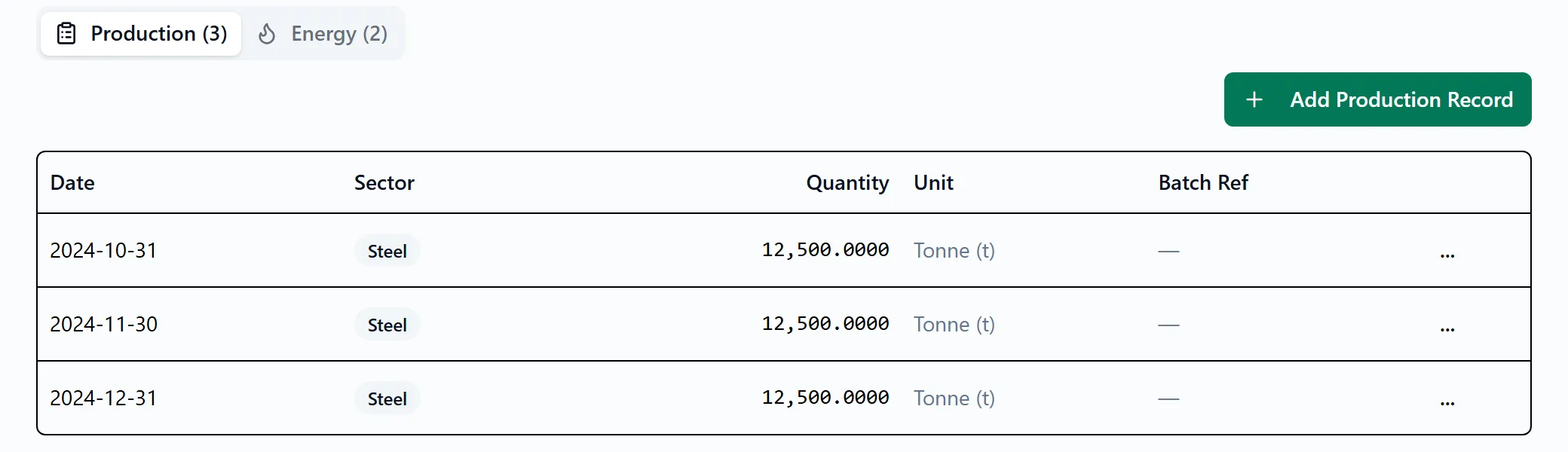
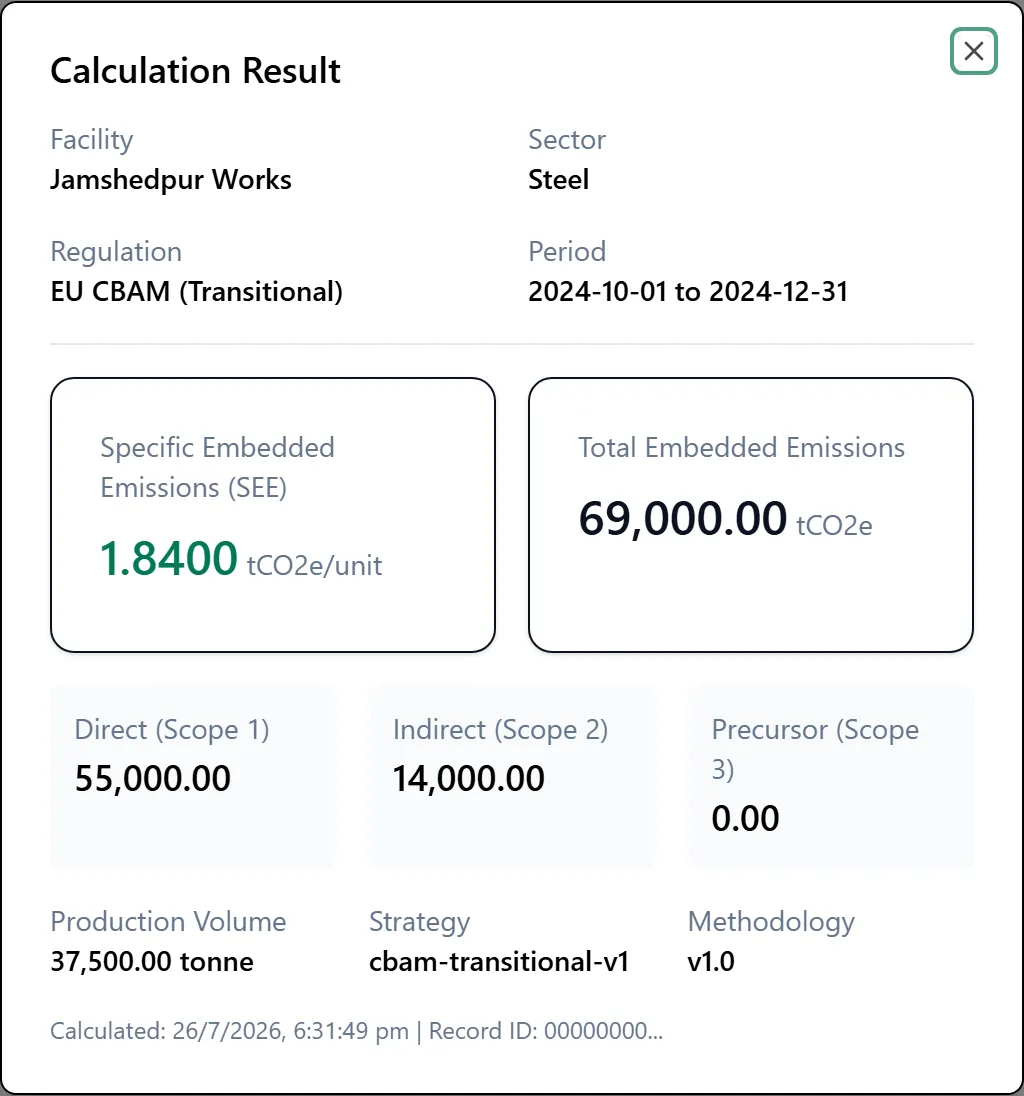
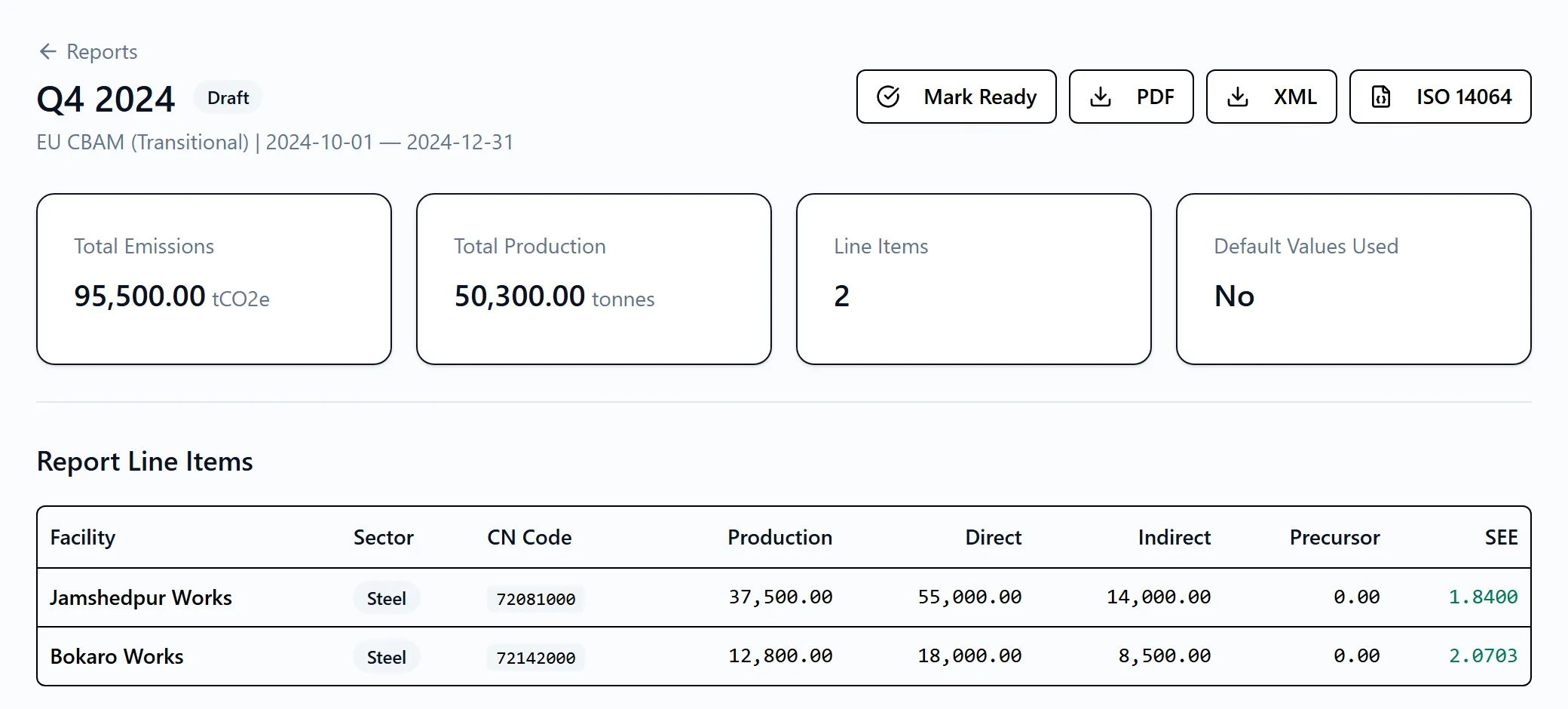
Enforced order
Nothing is filed that wasn't calculated. Nothing calculated without a traceable input.
§ 2
Default values
This is what the EU assumes you emit.
Default values are set above the real global average on purpose — they are what applies when nobody has proved otherwise. Every tonne you ship under a default instead of your own verified figure is priced as though it came from a worse plant than yours.
| Sector | tCO₂e / t | Assumed unless you prove otherwise |
|---|---|---|
| SteelCN 7208 | 4.28 | |
| Aluminium, unwroughtCN 7601 | 1.87 | |
| Cement, grey PortlandCN 2523 29 00 | 1.48 | |
| Fertiliser — ammonia, anhydrousCN 2814 10 00 | 3.28 | |
| HydrogenCN 2804 10 00 | 14.03 |
§ 3
Position
The definitive phase is not a future problem.
It started in January 2026. Certificates for emissions embedded in your 2026 shipments are declared and surrendered in September 2027 — which means the data you are recording now is the data you will have to defend.
EU CBAM · where you are now
- Oct 2023
- Transitional phase begins
- Reporting only — no certificates.
- Jan 2026
- Definitive phase begins
- Authorisation, verified reporting and certificate obligations are binding.
- Sep 2027
- First certificates due
- Declare and surrender certificates for emissions embedded in 2026 imports.
Definitive phase
checked 2026-08-09
§ 4
Who this hits
Two obligations, and plenty of plants carry both.
Exporting to the EU in a CBAM sector
- Steel
- Aluminium
- Cement
- Fertiliser
- Hydrogen
- Electricity
Obligated under India's CCTS
~490 entities already carry a binding target across CCTS's eight notified sectors — with a ninth, iron & steel, in draft. A domestic obligation: it applies whether or not you export anything.
Sectors Carbon Compliance supports today
- Steel
- Cement
- Aluminium (primary & secondary)
- Fertiliser (ammonia)
- Electricity
- Hydrogen
- Pulp & paper
- Textiles
- Chlor-alkali
- Petrochemicals
UK CBAM applies from January 2027, and the methodology is already in the engine.
checked 2026-08-09
checked 2026-08-09
Beyond
Where this goes
Compliance is the entry point, not the whole idea.
India is standing up a carbon market, and measurement is the part everything else rests on. A credit nobody can audit is worth nothing; a filing nobody can trace gets rejected. We are building the measurement layer — one verified record of what a plant actually emitted, good enough to file against, to issue credits from, and to defend to a third party.
Comply
Measure Scope 1, Scope 2 and embedded emissions from plant data. Out comes your CBAM report in the shape the EU expects, your CCTS position against your BEE target, and the evidence chain behind both.
Shipped
Account for the credits
Beat your CCTS intensity target and the surplus is worth something. Carbon Credit Certificates tracked projected → issued → held → traded → retired, against the calculation that produced them.
Shipped
Trade them
Settlement runs through a registered broker on a recognised exchange, behind an abstraction the platform already has — so a broker relationship plugs in rather than being retrofitted through the calculation layer.
Roadmap
Measure what isn't a factory
The same MRV spine applied to offset projects — biogas, agroforestry, paddy methane — where measurement is distributed instead of metered, and built against BEE's own offset methodologies rather than a generic carbon-accounting model.
Roadmap
Status is stated per item
Roadmap items are labelled as roadmap, not sold as shipped.
Next
One call
Get a straight answer on where you stand.
We look at your sectors, your export mix and the data you already keep, then tell you what CBAM and CCTS require of you — in plain terms.
30 minutes, free. Bring: your sector, what you export and to where, and a year of production and energy figures if you have them.You get: which obligations apply to which plant, the deadlines that bite first, and where your data falls short of what a verifier will ask for.
Book a compliance assessment